


Articolo del 15/12/2025
One of the greatest rewards is seeing the joy in a patient’s eyes at the end of an exam, when they learn that their treatment is working—evidence revealed precisely thanks to the PET scan. Comparing a follow-up PET scan with a previous one allows us to observe significant, positive changes for the patient. Sharing these results is undoubtedly one of the most rewarding moments of the day.
What is Nuclear Medicine? How Does It Differ from Traditional Imaging?
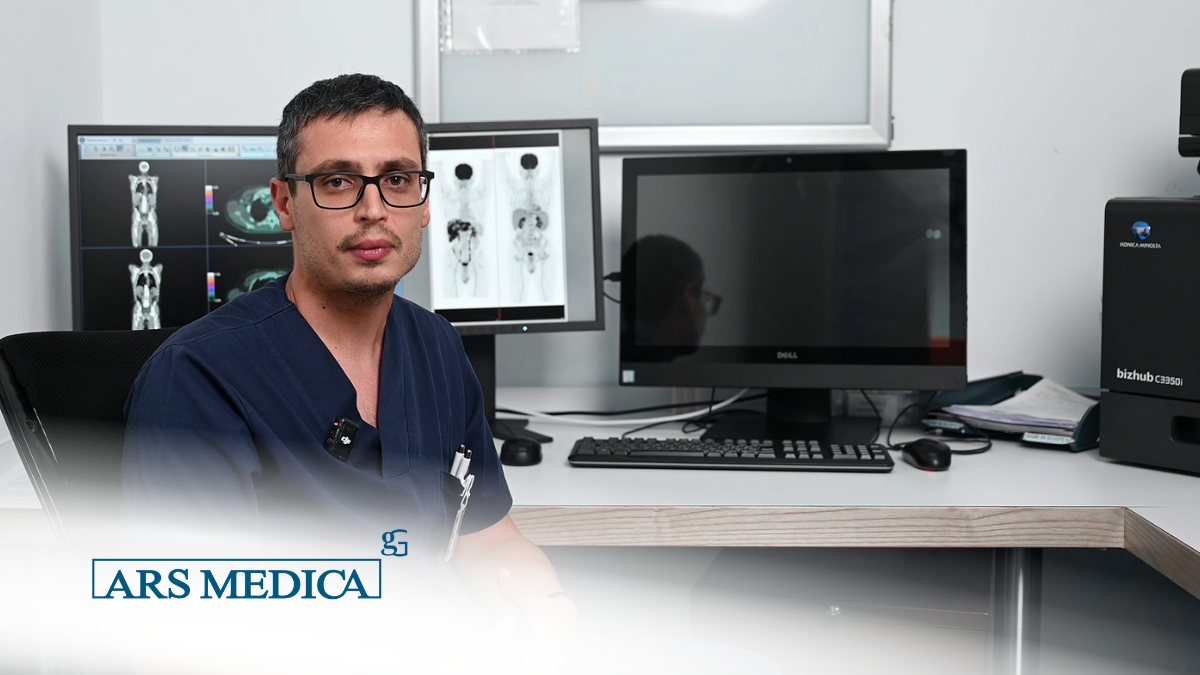
We spoke with Dr. Riccardo Camedda, nuclear medicine specialist and PET expert at Ars Medica Clinic.
Nuclear medicine is a branch of medicine that uses small amounts of radioactive substances, known as radiopharmaceuticals, for diagnostic and therapeutic purposes.
Are There Any Risks Associated with Nuclear Medicine Exams?
The term “nuclear” can understandably raise concerns. However, nuclear medicine exams are very safe. The amount of radiopharmaceutical administered is minimal—just enough to be detected by the imaging equipment.
For comparison, the radiation dose a patient receives during a nuclear medicine exam is roughly equivalent to that of a standard CT scan. Therefore, the benefits of early diagnosis, especially in oncology, far outweigh the minimal risk associated with these small radiation doses.
Unlike conventional imaging techniques—such as X-rays, CT scans, or MRI—which focus on the structure and morphology of organs and tissues, nuclear medicine primarily assesses function and metabolism at the cellular level. While traditional imaging relies on X-rays or magnetic fields to produce detailed anatomical images, nuclear medicine tracks the distribution of radiopharmaceuticals within the body.
These substances localize to specific organs or tissues, enabling functional imaging that shows, in real time, how organs and tissues are performing metabolically in vivo. This provides crucial information that complements structural imaging, allowing physicians to tailor therapies more effectively.
Can you give an example?
Let’s consider the most widely used tracer in oncology PET imaging today: fluorodeoxyglucose (FDG). Tumor cells have a particularly high metabolic activity—they replicate rapidly and therefore require a large amount of energy.
Administering a sugar-based tracer, which mimics glucose—a key fuel for cellular metabolism—allows us to detect tumor cells throughout the body, even when they spread beyond the primary lesion.
What Does PET Imaging Allow?
PET imaging goes beyond the structural characteristics of organs and tissues, enabling the identification of even very small lesions. It can detect metabolic changes before morphological alterations become visible, allowing for earlier and more precise diagnosis than conventional structural imaging methods.