



Articolo del 16/12/2025
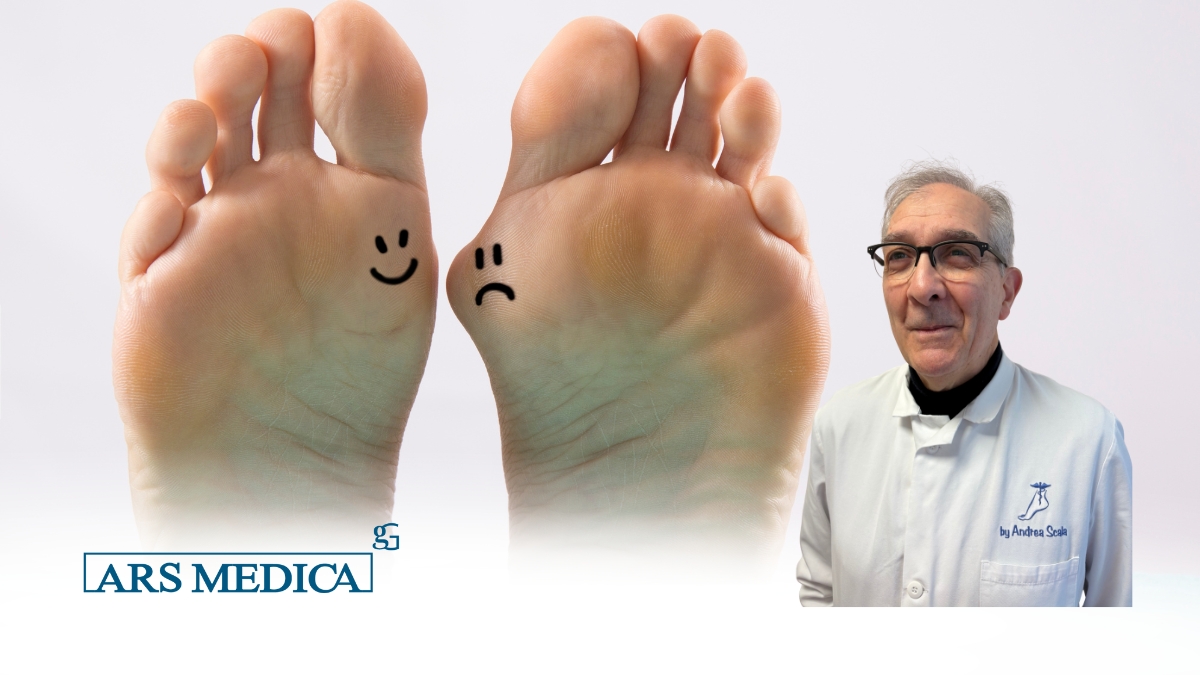
Hallux Valgus is a deformity affecting the front part of the foot. In simple terms, the big toe no longer remains straight but gradually deviates toward the other toes. This shift also alters the position of the first metatarsal, the bone connected to the big toe, creating the characteristic lateral prominence commonly known as a bunion.
Why does this bunion form? And is pain the main symptom?
We discuss this with Dr. Andrea Scala, orthopedic specialist at Ars Medica Clinic.
The bunion develops as a result of the bone moving outward and the constant friction against footwear. At the base of the big toe there is a bursa, a small cushioning structure designed to reduce pressure. When the big toe deviates, this bursa can become inflamed, leading to a painful bursitis.
Yes—pain is a clear signal that the anatomy of the foot is changing. If the condition is left untreated, the big toe continues to drift inward, eventually moving closer to the second toe. In some cases, it may even slip beneath it, contributing to the development of a hammer toe. Over time, patients may also experience significant pain in the sole of the foot (metatarsalgia) and progressive deformities of the other toes.
What role does the big toe play in posture?
A crucial one—often underestimated. During walking, the big toe bears a substantial portion of body weight. When it becomes deformed, proper weight distribution is lost, affecting overall posture. This can make activities such as running, dancing, and sports increasingly difficult.
Is this when metatarsalgia develops?
Exactly. When the big toe no longer functions correctly, body weight shifts to the lateral metatarsals and the smaller toes, overloading tendons, ligaments, and joints. Painful calluses often develop—frequently removed by patients without lasting relief, because the underlying cause remains unaddressed. This is why, when surgery is indicated, these pathological calluses must also be corrected at the same time.
Many procedures focus solely on removing the bunion. Does this work?
Unfortunately, no. Simply removing the bony prominence does not correct the underlying bone alignment. As a result, hallux valgus tends to recur, often to the frustration of both the patient and the surgeon.
Which surgical approach do you consider most effective?
The most effective procedure is a first metatarsal osteotomy performed using a minimally invasive percutaneous technique. The bone is precisely cut, repositioned, and realigned with the other metatarsals—without extensive incisions.
When selecting the surgical technique, bone quality is also a crucial factor. In young, athletic patients with strong, well-mineralized bones, we can use even more delicate techniques. In mature or elderly patients, sometimes affected by osteoporosis, specific precautions are taken to ensure proper healing and avoid complications.
Does the big toe need to be immobilized after surgery?
Absolutely not. The big toe is not a rigid structure—it is a joint, and it needs to move immediately after realignment. Immobilizing it with steel wires or for prolonged periods can significantly compromise joint recovery and make rehabilitation much more difficult.
What does the post-operative recovery look like?
Patients are able to walk using a specialized post-operative shoe. Typically:
-
Dressings are changed every 15 days
-
Daily activities can be resumed after about 1 month
-
Training can restart at around 2 months
-
Full return to competitive sports usually occurs by the third month
A final thought for our readers?
Taking care of your feet means taking care of yourself. Pain should never be ignored. Today, hallux valgus can be corrected safely, respectfully, and with long-lasting results, always with the patient’s present and future well-being in mind.